
Why Workforce Training Looks Different in Rural Montana

Updated: Sep 28
By Dr. Katherine Booher, Director of Workforce Partnerships, Accelerate Montana

Montana is the fourth largest state by area, but despite its vast geography, the state’s population density is the third lowest in the country1. As reported by Montana State University's Center for Research on Rural Education, 96% of the state’s public school districts are classified as “small rural.” The challenges that residents in rural communities may face accessing workforce training opportunities are not entirely unique, but they are compounded by the distance it takes to travel to two-year colleges or adult education centers that often provide training opportunities.
52% of Montana counties are considered childcare deserts, and four counties have zero licensed childcare providers2.
Online training is not a silver bullet: approximately 1 in 6 Montanans cannot buy a basic broadband connection where they live3.
In many Montana communities, public transportation and private ride share options are limited or non-existent.
Students from rural communities often face unique challenges when they matriculate to postsecondary institutions, from balancing homesickness, culture shock, and seasonal obligations at home, such as harvest.
The barriers are real, but so are the opportunities to think creatively about locally-rooted approaches.
Training and Credentials that Travel
One approach to bolstering access to workforce development opportunities in rural areas is by working to develop trainings that do not require participants leave their communities and that can be delivered flexibly to account for things like childcare, transportation, access to broadband, and work responsibilities. In essence, short-term, skills-based training that can travel. Even better? These trainings can lead to credentials that have real value as learners move into the workforce, pursue apprenticeship, or attend college.
At Accelerate Montana, we have tested what it looks like to deliver training this way. Through the support of a Lowe’s Foundation Gable Grant, we have designed and deployed a mobile unit that travels to deliver construction trades training in every corner of the state. This truck and trailer combo is bringing the tools, materials, and instructional expertise directly to learners where it otherwise may not exist. This mobility matters; 1 in 3 Montanans live more than an hour’s drive from a college or university. For comparison, in Texas, a state almost twice the size of Montana, that figure drops to just 1 in 104 .
Importantly, our approach is deliberately partnership-based. When the mobile unit visits a community, we work in tandem with a local host who can help us understand demand for training, employment opportunities, and key wrap-around services.
In Troy, MT (Northwest Montana, population ~800) we partnered with the local library, Job Service office, and school district. Through their local expertise, these partners helped identify candidates interested in the training, provided learners access to computers and internet to work on online training
,and the resources needed to tap into local job opportunities after training was complete.In Browning, MT (Northwest Montana, Blackfeet Reservation, population ~1,000) we partnered with the Blackfeet Nation Tribal Employment Rights Office. Their recruitment and support of interested candidates resulted in the majority of trainees having job opportunities lined up before training even ended.
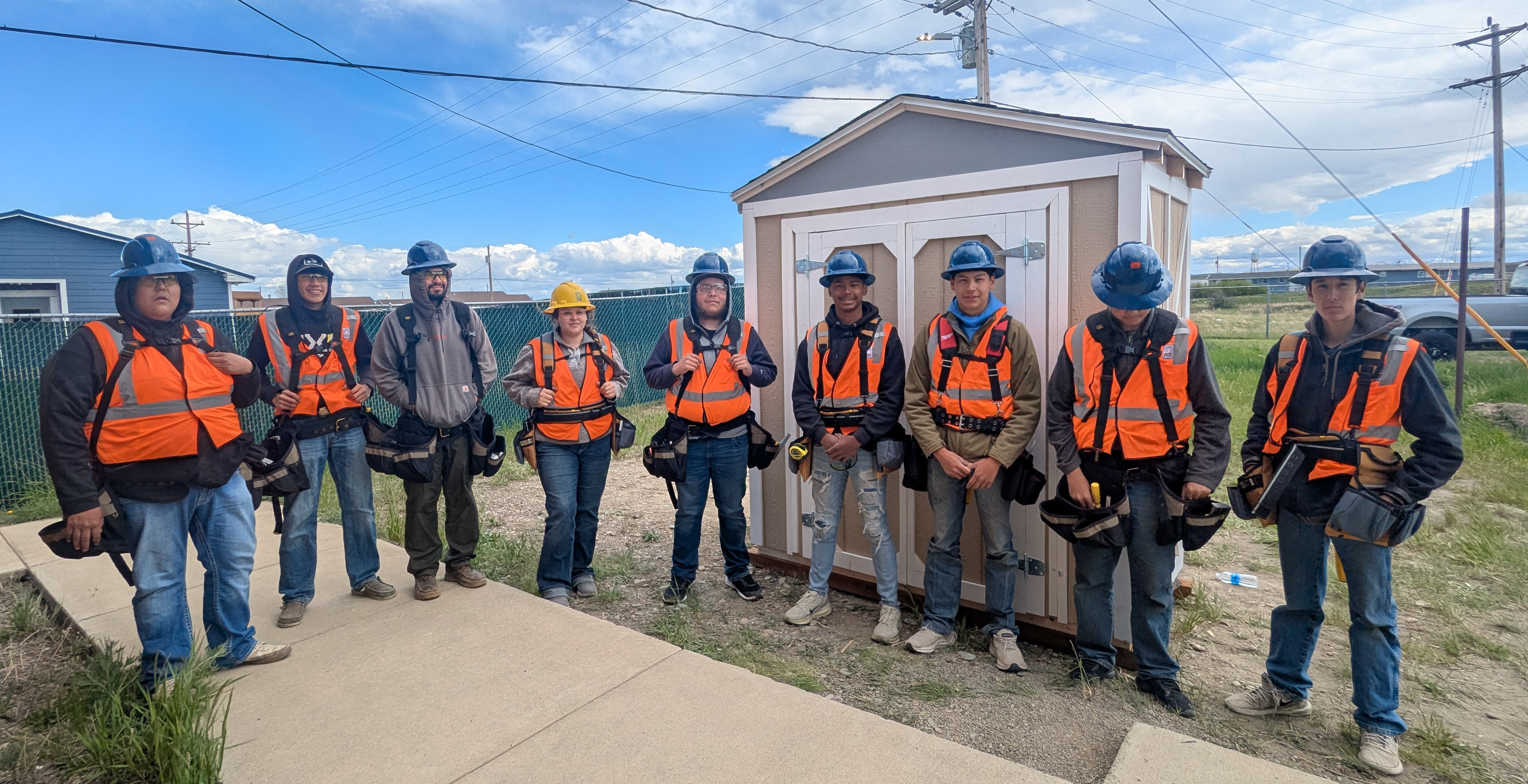
Since the mobile training first hit the road in July of 2024, we have delivered 20+ cohorts in communities across Montana, from Miles City to St. Regis, Poplar to Hamilton. The relationships that make these trainings successful look different, but the curriculum and importantly, credentials are the same. In 2025 alone, the mobile training unit traveled over 4,000 miles over roughly six months, the same distance it would take to drive from Seattle to Chicago and back.
Whether trained in one of Montana’s urban centers, like Missoula, or in a smaller community like Red Lodge (population ~3,000), trainees complete the requirements to earn the Job Site Ready credential, which has real portability as credit into some 2-year college construction trades programs, as part of Related Training and Instruction (RTI) in a registered apprenticeship, or as a credential to signal pursuing their first construction job. Short-term workforce trainings are not in competition with other valuable skill-building pathways like apprenticeship or college. In fact, these experiences can be stackable, integrated pathways that make the next step possible.
Building Local Capacity

Mobile delivery answers a distance problem, but the trailer leaves, the mountain passes ice over stalling travel, and the next cohort may be a calendar year away. Mobile training does not answer the permanence question, and a well-attended small-town cohort actually tells us that the demand is there. So, what if we build something that stays? Mobile training is a low-risk way to test demand in a community that no institution would build a campus for. The question is what happens when demand is there.
As we continue to use the mobile training initiative to serve Montana communities with the greatest need, who are the furthest from opportunity, we also want to support local capacity building and work with partners across the state to build shared infrastructure.
We are now exploring what it looks like to operationalize a train-the-trainer model that could support local organizations in offering Job Site Ready and Electro-Optics Assembly Technician Trainings in their own communities, on their own timelines.
Train-the-trainer initiatives let high school students earn real credentials before they graduate and let teachers deliver them. Through shared curriculum and targeted professional development, a high school teacher can offer an industry co-created program that is flexible enough to respond to the needs of their students and the constraints of the setting that they work in and has practical applications in their own backyard. Montana's labor market is tight, and the emerging workforce is where advanced manufacturing will find its next generation of technicians.
We're scaling this approach now, building on a successful pilot of our Electro-Optics Assembly Technician program designed with the Montana Photonics and Quantum Alliance and delivered last year at Belgrade High School by an industry expert. The advanced manufacturing industry keeps growing, but industry can't staff a classroom in every Montana town. What we can do is equip the people who already know how to teach to expose students to these career pathways and partner with local industry to bring real world, regionally specific use-cases to life.
It’s All About Perspective
Context is key, and measuring the impact of workforce development programs that serve rural communities requires an understanding of the relative impact that these programs can have on communities, even if cohort sizes might be small.
For example, in a community of about 3,500 (think Libby, Shelby, or Glasgow), adding even a small number of additional skilled trades people makes a palpable difference5. Further, Montana is a state of small businesses. Nearly all (99.2%) of Montana businesses are classified as small businesses and collectively employ 66.3% of the state’s workers 6. This changes the math on workforce development, particularly in Montana’s rural communities. The employer waiting on the other side of training is rarely a 100+ employee outfit hiring for multiple roles a year across several locations. It is often a 5-person crew who has turned down more work than they have taken, because they can’t find the workforce to grow.
That same crew may have no training budget, no HR department, and no capacity to release a new employee for long periods of time to train. In markets dominated by large employers, companies build their own pipelines, because they can amortize the cost across hundreds of hires. Montana's smaller employers often can't, and it isn't for lack of will; the math simply doesn't work. Philanthropic and public investment play an important role in addressing the gap, underwriting shared infrastructure that no single business could justify building alone, but that communities depend on to survive. The same logic applies to how these programs get measured. A cohort of six looks small until you consider what 6 credentialed professionals can do to an median sized Montana town (,1,000 people) or what one of them does to a five-person crew that has been turning down work. Scale is the wrong lens. Impact is the right one.
The Good News? Early Returns.
There is no one-size-fits-all solution to rural workforce development, but there is early evidence that community-led, localized solutions can work.
Across Accelerate Montana training programs, our most recent data shows:
Learner employment increased by 21% within six months of training
Learners experienced an average of 6% wage increase within six months of training
In addition to real employment and wage increases, learners are walking away with a belief in their own abilities that they can carry with them as they begin their careers. As one recent Job Site Ready learner reported, “[the training] made me look and say, hey, I can actually do things if I put my mind to it.”
A credential shows up on a resume. Its effects show up in a household, a crew that can finally take the job, an education pathway that hadn’t been considered possible before, and a town that keeps a family it might have lost. The cohorts may be small, but the impact is not.
Interested in learning more or partnering to bring training opportunities to your community? Reach out at katherine.booher@acceleratemt.com.
Dr. Katherine Booher serves as Director of Workforce Partnerships at Accelerate Montana, where she works with communities, employers, educators, and workforce partners to expand access to skills-based training across Montana.


Comments